
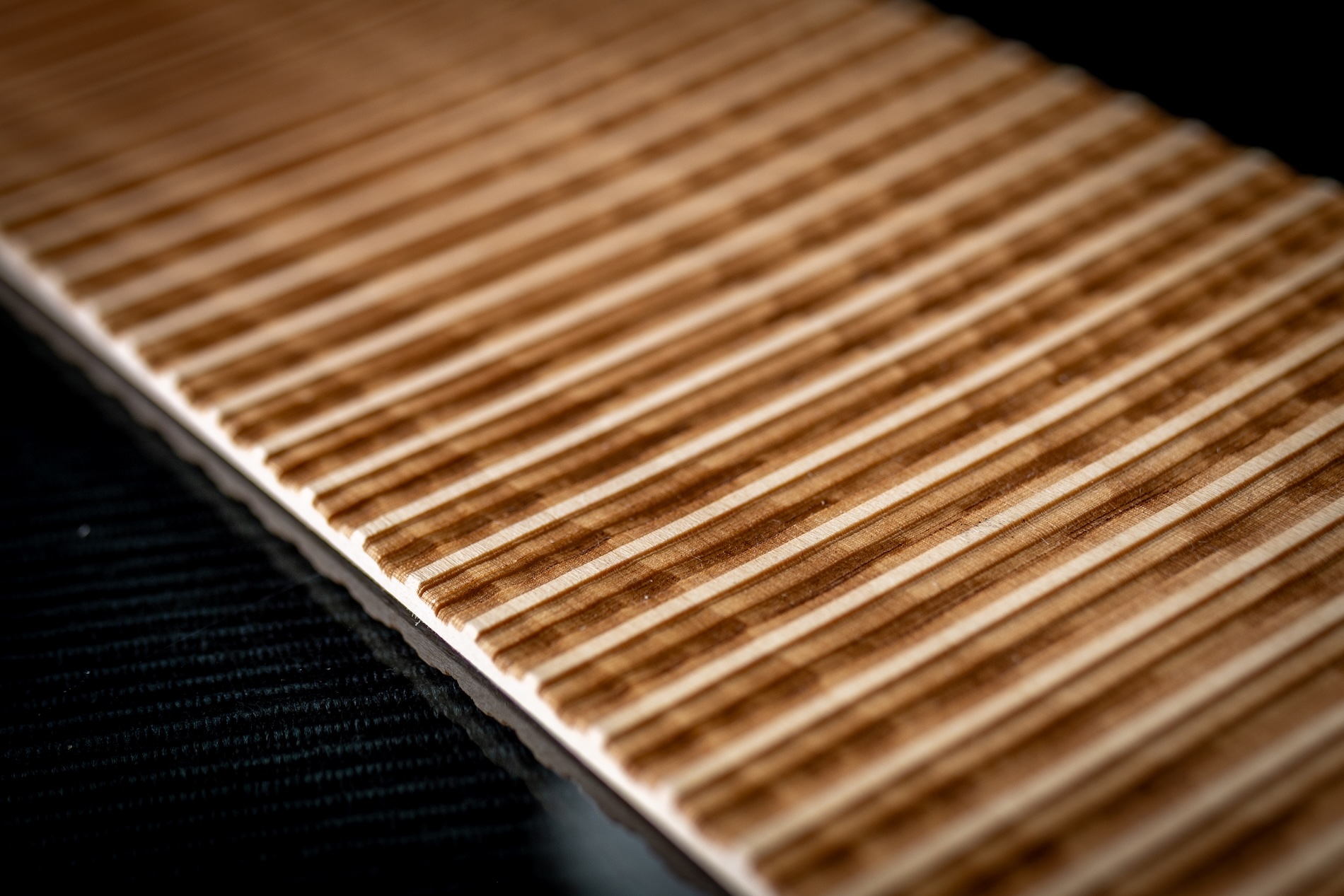
When wood meets laser precision and quality
Laser wood engraving is a production technique with infinite potential for designers, interior architects, furniture manufacturers and companies in the decorative coatings sector.
The contemporary design market is demanding increasingly personalized surfaces. Textures that tell a story, materials that combine the naturalness of wood with the precision of industrial technology are increasingly sought after. And this is exactly where laser woodworking has found its ideal habitat, establishing itself as a reference technology for high-profile results.
But what are the most sought-after applications in laser wood engraving in the design industry? We see the creative possibilities and technological advantages that the latest generation industrial systems, such as OT-LAS laser machines, offer to those who work this noble material.
Why the laser is the ideal tool for working wood in design
Wood is an extraordinary but also delicate material. Each grain is different, each species reacts slightly differently to heat, each thickness requires careful calibration. For decades, decorative woodworking remained anchored to traditional techniques such as CNC milling, hand carving, and punching. However, these solutions have several limitations in terms of accuracy, speed and flexibility.
Laser engraving changed the rules of the game radically. The CO2 laser beam interacts with the wood sublimating the material in a controlled manner. Machining takes place without mechanical tools that wear out and without vibrations that can compromise accuracy. The result is superior quality workmanship, repeatable with millimeter precision, adaptable in real time to any vector design.
OT-LAS laser systems, equipped with state-of-the-art galvanometric heads, take this accuracy to the next level. The galvanometric head allows for faster processing than a traditional mechanical system, paving the way for complex patterns and very fine textures. Such workings were once simply unfeasible, especially on an industrial scale.
The most requested applications in laser wood engraving for design
1. Geometric Patterns and Decorative Textures: From Texture to Striped Effect
One of the most requested applications of the design market is the creation of specific geometric patterns and textures on wooden surfaces. Wall panels, furniture fronts, cabinet doors, decorative ceilings: the laser allows you to transform a flat surface into an impactful visual element.
Among the most sought-after patterns, a prominent place is occupied by the striped effect, which can be achieved by creating parallel, continuous or dotted lines. The use of rows can also be used to create the effect “tile joints”. This is a pattern that reproduces the pattern of the joints of a tiled pavement. Parallel and perpendicular lines intersect to create a visually ordered grid, with an effect of varying depth and rhythm.
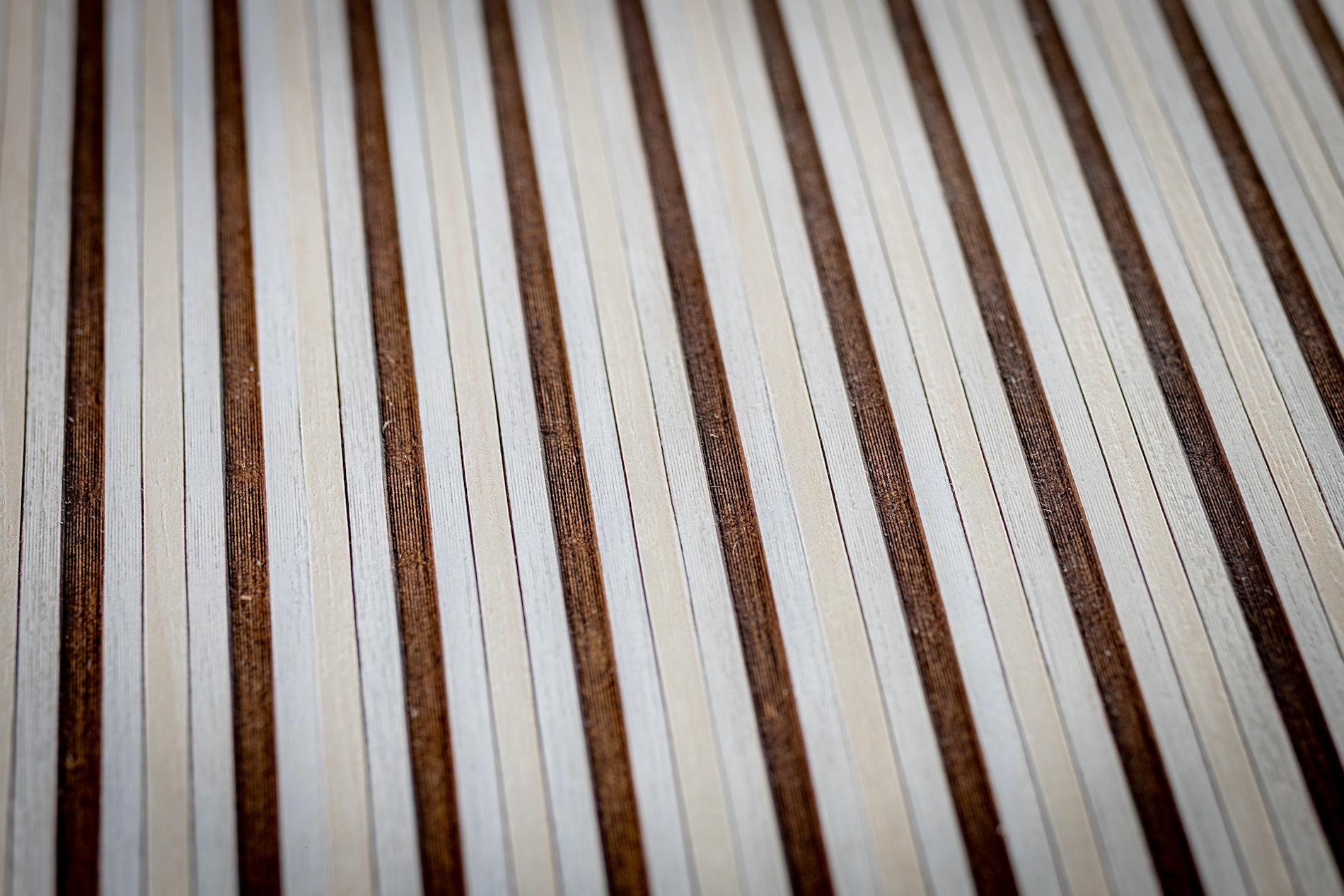
This effect, when applied to wood with laser precision, produces aesthetic results of exclusive refinement. The contrast between the natural wood and the engraved parts creates a play of color and three-dimensionality that enhances the grain of the material. Furthermore, it adds a tactile and visual rendering that no pictorial surface treatment could replicate with the same authenticity.
Applications of the laser etching escape effect on wood
The laser-etched tile escape effect on wood panels finds application in many wall coverings. In luxury residential and hospitality environments, or in designer kitchens, the wall panel takes up the theme of ceramic flooring. In the fronts of furniture that dialogue with hard surfaces and in the heads of beds, the geometric texture creates a scenographic focal point.
The strength of this application lies in the possibility of infinitely modulating the parameters. The laser can vary the width of the etching from a few tenths of a milliter up to several centimeters. The depth of etching can range from a surface scratch to a bas-relief, while the pattern pitch ranges from dense textures to large fields. All while maintaining absolute repeatability on even very large formats, thanks to the precision guaranteed by systems such as CX and CX-XL fly marking by OT-LAS.
Laser engraving pattern “herringbone”
In addition to the classical orthogonal grid, the same logic can be declined in herringbone (chevron) patterns. These hexagonal patterns recall cement tiles, out-of-phase grids reminiscent of Roman opus incertum, or compositions of squares of different sizes that create a sophisticated patchwork effect. In all these cases, the laser ensures the geometric perfection that makes the pattern professional and industrial.
2. Bas-reliefs and three-dimensional textures
Another rapidly growing category of applications is that of laser bas-reliefs on wood. Bas-relief uses the laser’s ability to gradually remove material by working on multiple passes or modulating the beam power to obtain surfaces with variations in altitude.
The result is a wooden surface that has true three-dimensionality. Floral patterns, waves, surfaces that imitate leather or stone, textures that appear sculpted are created in a few minutes by a laser machine.
Laser bas-reliefs are widely used in the creation of high-end decorative furniture panels. In particular, for the luxury market, product customization and uniqueness are crucial. An oak panel with a bas-relief depicting a botanical motif can become the scenic center of a luxury dining room. A walnut head read with laser-etched waves transforms the chamber into an exclusive space.
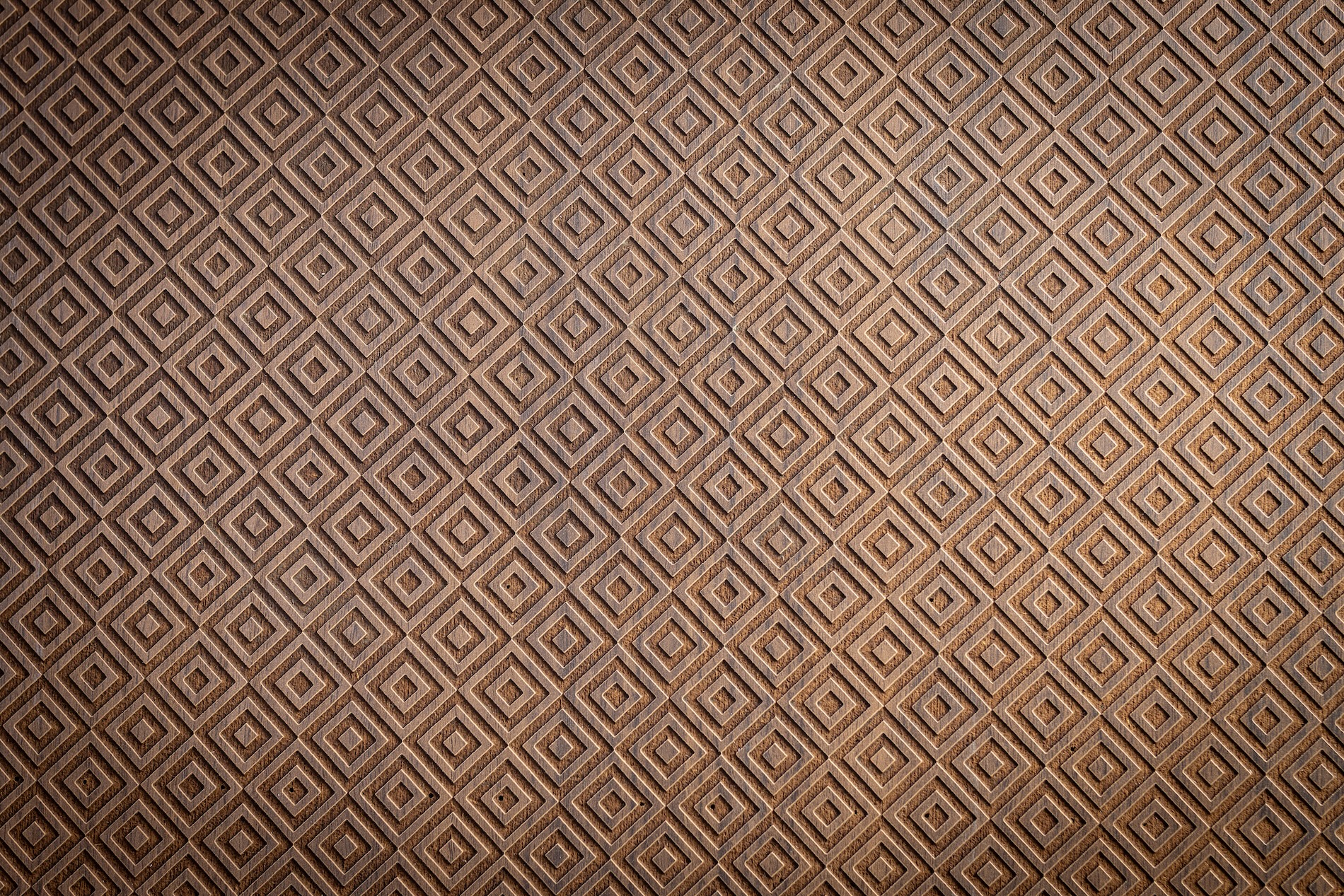
OT-LAS laser systems dedicated to woodworking are designed to handle these processes with maximum precision. The results remain uniform even on large surfaces.
3. Graphic engraving and customization: logos, texts, illustrations
In product design and furniture, the end consumer looks for pieces that have an identity, a signature, or an element of uniqueness.
Laser engraving on wood perfectly meets this need. Precisely engraved company logos, celebratory names and dates on fine wood objects, and personalized illustrations are increasingly in demand. Particularly interesting is the application in luxury wooden packaging. Laser-engraved wooden boxes, caskets, and cases featuring the brand’s logo and graphics become communication objects that the end customer retains over time.
The ability of OT-LAS laser systems to switch from complex graphic etching to a geometric pattern offers maximum efficiency even in productions where product variability is high.
4. Micro-drilling of wood panels: when emptiness becomes design
Among the most fascinating and technically sophisticated applications of laser wood engraving is microperforation. This type of processing allows for the introduction of functional micro-drilling on MDF panels, veneers or laminates, to obtain sound-absorbing panels. Micro-perforation, combined with the engraving of patterns and decorations, allows for highly impactful visual, light, and tactile effects.
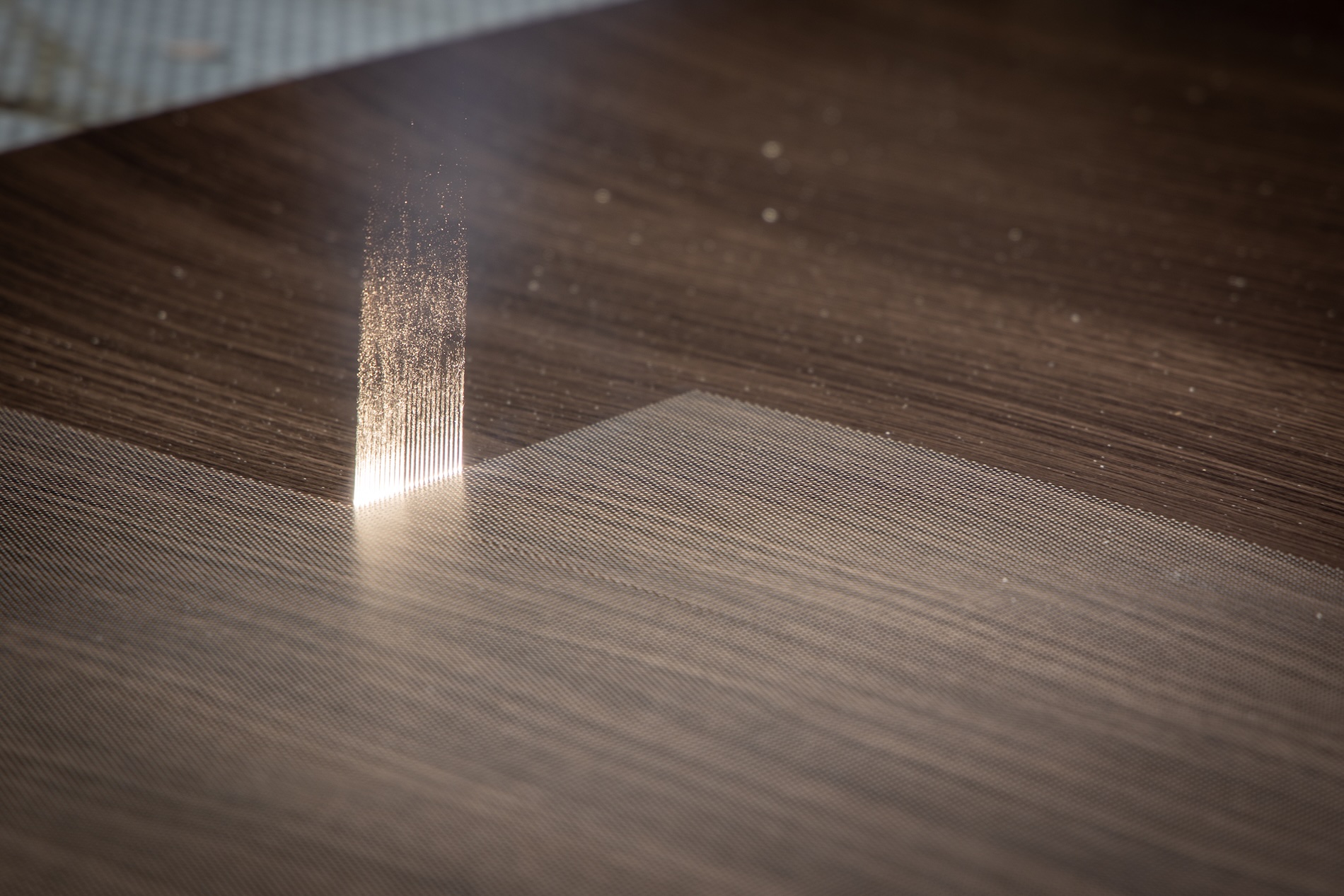
OT-LAS laser systems for microdrilling on wood
OT-LAS systems specifically designed for microperforation, such as PX and CX Microperforation, can perform micro holes ranging in diameter from 0.3 mm to 1 mm with exceptional precision and flexibility. This opens up completely new creative possibilities, which allow the functionality of the micro-perforated acoustic panel to be combined with the unique design of the laser engraving.
5. Processing of veneers and fine woods
The laser is especially valuable when working with veneers and fine woods. Veneers are sheets of noble wood of reduced thickness, often less than a millimeter, applied to cheaper supports to enhance the aesthetics of the surfaces. Working with traditional technologies is risky: cutters can tear them, punching machines can crack them, and water from chemical processes can inflate them.
The laser, having no contact of tools with the material, can engrave veneers with a delicacy and precision impossible for other technologies. With the laser you can obtain decorative patterns, inlays created by alternating engraved and unengraved areas, and very fine-grained textures that enhance the character of the wood. These processes find application in luxury furniture, nautical finishes and high-end automotive, for example.
OT-LAS has developed specific expertise in this area, with laser solutions optimized for veneer processing that guarantee flawless results even on the most delicate materials.
6. Wall coverings: Laser meets interior architecture
The wall cladding sector is one of the areas where laser woodworking has found greatest expression in recent years. Interior architecture has rediscovered wood as the primary material for vertical surfaces, both for residential and contract purposes.
Laser engraving allows you to create wooden wall coverings with exclusive characteristics. The natural heat of wood is enhanced by high-precision machining for refined and customized surfaces.
This type of solution is highly appreciated in the design of luxury hotels, restaurants, public representative spaces and contemporary offices. Laser-etched patterns on wood wall cladding panels can range from simple streaks to complex modular compositions, fabric-imitating textures, and abstract, figurative motifs of particular beauty.
OT-LAS offers specific solutions for this market in the wall coverings and interior sector, with machines designed to ensure uniformity of workmanship even on large formats.
Which OT-LAS laser machine to choose for wood design?
The answer depends on the type of application prevalent and the size of the workpieces. OT-LAS offers a full range of wood laser systems, each optimized for specific production needs.
For decoration and engraving on medium-large format pieces, the CX and CX-XL systems are the reference solution. The CX system is a high-throughput CO2 laser machine, suitable for mass processing of wood panels with complex decorative patterns, striped effects, bas-reliefs and graphic engravings. The CX-XL model further extends the scope of work to cover the larger formats required by the wall cladding industry.
For microperforation on acoustic and decorative panels, OT-LAS’ PX and CX Microperforation systems are the ideal choice. Equipped with ultra-precision galvanometric heads, they can perform microhole patterns with exceptional density and complexity. These systems ensure processing quality, operational flexibility and energy sustainability.
All OT-LAS systems for wood are designed and built entirely in Italy, with a philosophy of technical excellence and attention to quality that is reflected in production results. The OT-LAS team offers customized technical advice to identify the best solution for each specific production need.
The competitive advantages of lasers in furniture and design production
Those who produce furniture, coatings and design objects today have very concrete reasons to evaluate the adoption of industrial laser systems in their production process. Among the main ones:
- Superior and repeatable quality. The laser ensures consistent machining quality on each piece, regardless of pattern complexity and production volume. There are no tools that wear out and degrade quality over time, there are no vibrations that compromise accuracy on large-format workpieces. The hundredth piece is identical to the first, the hundredth panel of one cladding is perfectly aligned with the others.
- Flexibility and customization at no additional cost. With laser, switching between patterns simply requires uploading a new file. There are no molds to replace, cutters to resharpen, complex mechanical setups. This means that customization on small batches, or even on unique pieces, becomes economically viable.
- Production speed. OT-LAS laser systems with galvanometric heads operate at high speeds, significantly reducing production times compared to traditional technologies. This results in increased production capacity and a faster response to market demands.
Waste reduction and sustainability. The laser works without physical contact, does not generate chips, does not require disposable tools. The precision of the processing minimizes the necessary finishing and material waste. For an industry like wood design, where materials are often valuable and expensive, this aspect has a significant economic impact. - Opening to new markets. The ability to offer wood surfaces with advanced laser processing, such as striped effects, decorative microperforations, complex bas-reliefs, opens the door to high-profile market segments. Luxury hospitality, nautical design, high-end automotive, and international contracts are some of the sectors accessible with high-precision manufacturing.
OT-LAS laser systems for wood represent the Italian industrial response to this demand for quality, flexibility and innovation.
Do you want to bring laser woodworking into your production process? The OT-LAS team is at your disposal to evaluate together the solution that best suits your needs. Contact us for more information.